Every Champion building is a complete engineered system. We combine advanced structural analysis with high-strength galvanized steel and tensioned membranes to create structures that last for decades.
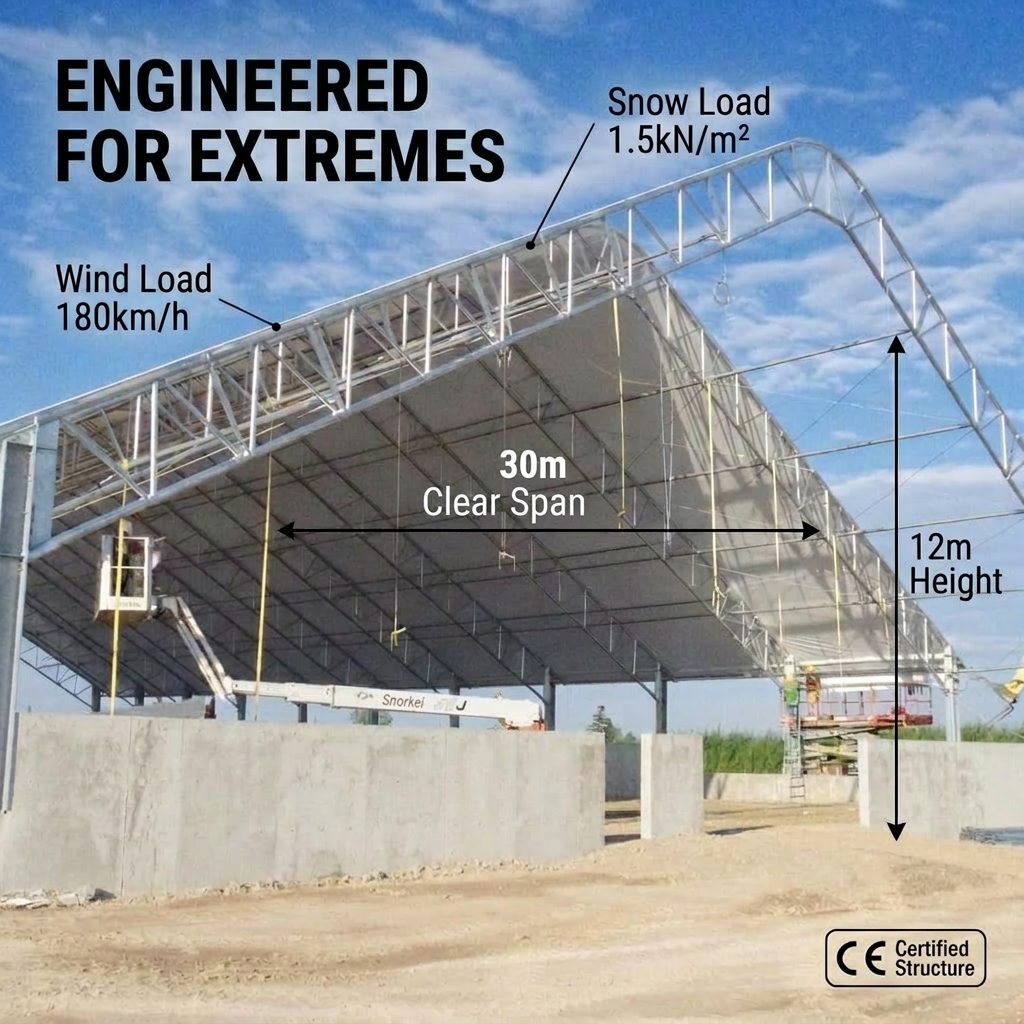
Structural engineering is the core of what we do. Unlike generic "all-weather" shelters, every Champion building is designed for the specific wind, snow, and seismic conditions of its installation site. We use finite element analysis (FEA) to optimize every truss chord, purlin, and connection.
Our philosophy is built on three pillars: safety, longevity, and efficiency. By precisely calculating the loads, we provide a structure that is strong enough for the harshest storms but optimized to reduce material waste and shipping costs.
We engineer the membrane, the frame, and the foundation as a single integrated unit.
Our engineering and manufacturing processes are certified to international quality standards.
From initial site data to certified drawings, here is how we bring your project to life.
We gather your location, terrain category, and intended building use to determine the baseline load requirements.
We calculate wind, snow, seismic, dead, and live loads according to your local building code (ASCE, NBC, Eurocode).
Truss members, purlins, and bracing are sized using structural software to ensure all stress ratios are within safety limits.
We design the critical base plates and bolt patterns to transfer loads safely into the foundation.
We provide full engineering packages, including stamped calculations and assembly drawings for permitting.
How we account for every force acting on the structure.
Calculation of pressure, uplift, and drag based on site exposure and building height. Learn more →
Analysis of ground snow, drift patterns, and unbalanced loads for cold climates. Learn more →
Design for earthquake-prone zones and standard dead/live loads (equipment, fire suppression, etc.).
Every element of a Champion building is engineered for performance.
High-yield galvanized truss systems designed for maximum clear span.
Engineered fabric tensioned to resist flutter and environmental degradation.
Hot-dip galvanizing to ISO 1461 for long-term durability in harsh sites.
Engineering for concrete pads, screw piles, or ballasted relocatable mounts.
Champion buildings are designed to meet or exceed global engineering benchmarks.
| Category | Standard / Code | Description |
|---|---|---|
| Structural Design | ASCE 7-22 / EN 1991 | Minimum design loads for buildings and other structures. |
| Steel Structures | AISC 360 / Eurocode 3 | Specification for structural steel buildings. |
| Welding | AWS D1.1 | Structural welding code for steel. |
| Galvanizing | ISO 1461 / ASTM A123 | Hot dip galvanized coatings on fabricated iron and steel articles. |
| Quality Management | ISO 9001:2015 | Global standard for quality management systems. |
| European Compliance | CE Marking | Compliance with EU health, safety, and environmental protection standards. |
Yes. We routinely engineer buildings for high-wind and cyclonic regions (e.g., Caribbean, Coastal Australia) with wind speeds exceeding 200 km/h.
We provide the reaction loads and base plate designs. While we can provide standard foundation drawings, we recommend a local engineer for site-specific soil analysis and final foundation certification.
Standard designs can be engineered in 1-2 weeks. Complex custom projects or those requiring full stamped calculations typically take 3-4 weeks.
Yes. When engineered correctly, they meet the same building codes as traditional steel or concrete structures for safety and load-bearing capacity, while offering more flexibility and faster installation.
Our engineers are ready to help you design a building for your site's exact needs.
Get Started Today