ASCE 7
The American Society of Civil Engineers standard for minimum design loads for buildings and other structures.
Ballast Foundation
A foundation system that uses weighted blocks (concrete) to secure the structure without ground excavation.
Bay Spacing
The distance between two consecutive structural frames or trusses along the length of the building.
Catenary
The curve formed by a cable or membrane under its own weight or tension, critical for load distribution.
Cladding
The external 'skin' of the building, which in our case is the high-tenacity PVC or PVDF membrane.
Clear Span
The horizontal distance between the two inner faces of the structural supports, with no internal pillars.
Eave Height
The vertical distance from the ground to the point where the sidewall meets the roof.
Flame Retardant
A material property that prevents or slows the spread of fire, typically certified to B1 or M2 standards.
Gable
The triangular portion of a wall between the edges of intersecting roof pitches.
Hot-Dip Galvanizing
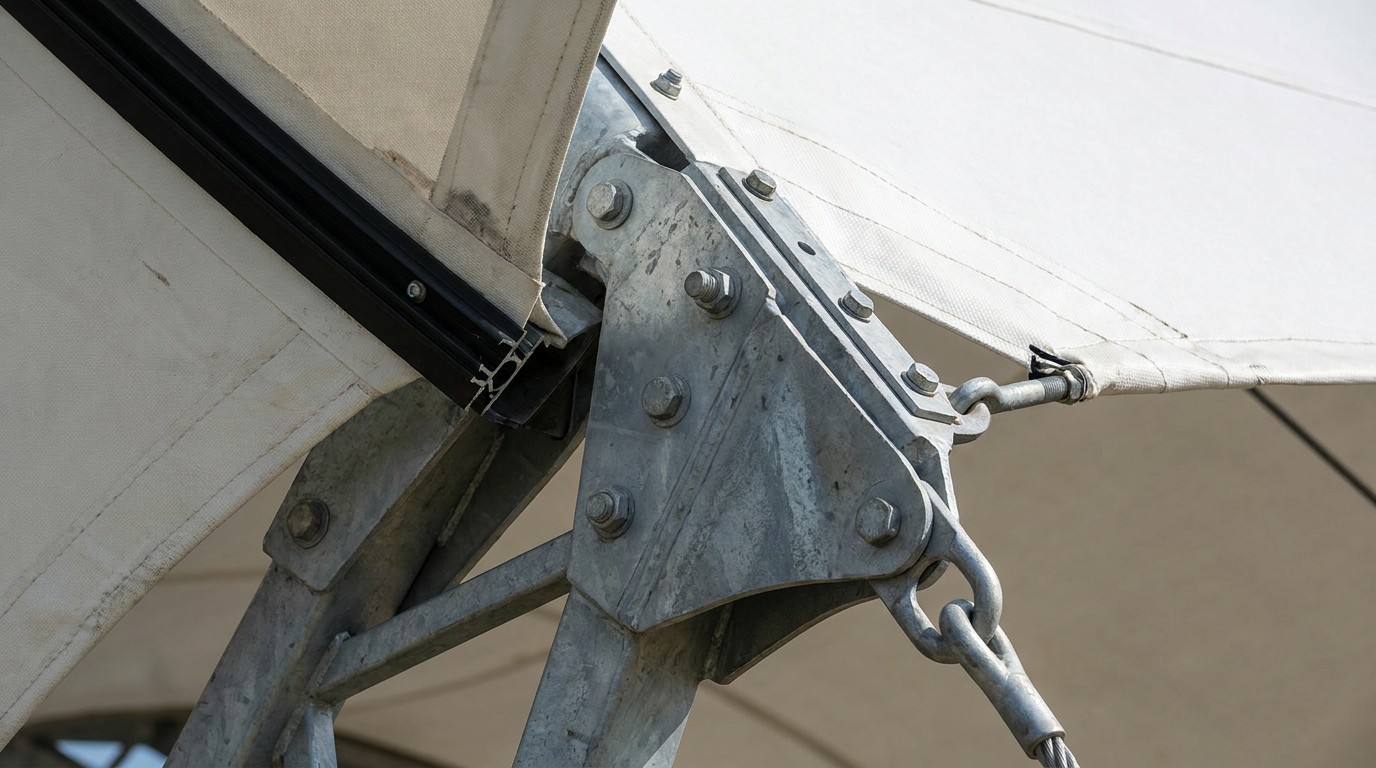
The process of coating steel with a layer of zinc by immersing it in a molten bath at ~450°C (ISO 1461).
GSM (Grams per Square Meter)
The standard unit of measurement for the weight and thickness of the architectural membrane.
Hoop Structure
A structure using curved tubular frames, typically for smaller spans or temporary applications.
ISO 1461
The international standard for hot-dip galvanized coatings on fabricated iron and steel articles.
Keder
A heavy-duty bead welted to the edge of the fabric, used to slide into an aluminum or steel track for tensioning.
Membrane
The flexible, high-strength fabric (PVC or PVDF) that serves as the building's roof and walls.
Purlin
Horizontal structural members that span between the main frames to support the cladding.
PVC (Polyvinyl Chloride)
The primary polymer used for architectural fabric coatings, often reinforced with polyester scrim.
PVDF (Polyvinylidene Fluoride)
A high-end lacquer coating applied to PVC for superior UV resistance, self-cleaning, and lifespan.
Q235B / Q355B
Standard Chinese structural steel grades, roughly equivalent to ASTM A36 and A572 Grade 50 respectively.
R-value
A measure of thermal resistance; higher values indicate better insulation performance.
Snow Load
The downward force on a building's roof from the weight of accumulated snow.
Span
The horizontal distance between the supports of a structure.
Translucency
The property of the membrane that allows light to pass through without being transparent.
Truss
A framework composed of members joined together to form a rigid structure, typically triangular.
Wind Load
The pressure or suction exerted by wind on a structure, calculated based on speed and topography.